
Firefighter and Police Physical Fitness Tests Are Now Completely Different Formats -- Point-Scoring by Event vs. a Timed Circuit Course
Firefighter hiring still scores individual events, while police (patrol officer) exams switched to a timed circuit test starting in 2026. Here's how the two formats actually differ.
For both firefighter and police civil service exams, the physical fitness test can decide the outcome just as much as the written exam -- but starting in 2026, the two tests have split onto completely different paths. Police (patrol officer) hiring has moved entirely away from measuring individual event records and switched to a "circuit-style fitness test" that has candidates complete a course simulating real field movements, while firefighter public recruitment still uses the older point-scoring system that grades each event separately. Which track you're preparing for changes how you should train.
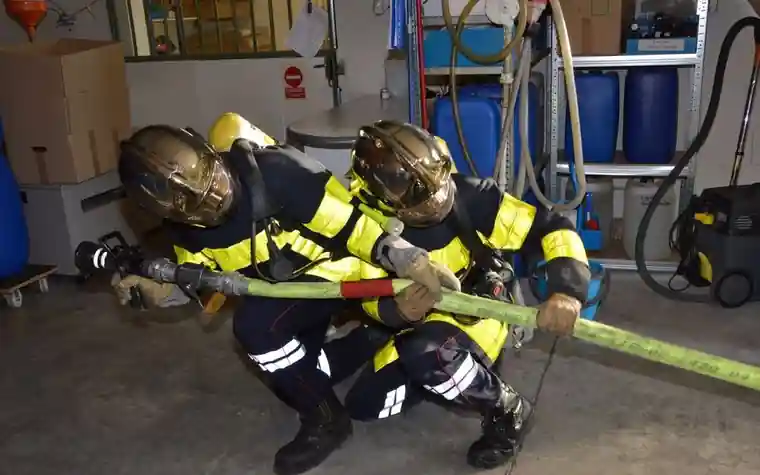
Firefighters -- still a 6-event scoring system
The 2026 firefighter public recruitment physical fitness test consists of six events: grip strength, back strength, sit-and-reach, standing long jump, sit-ups, and a shuttle run. Each event is scored on a scale of 1 to 10 points based on the performance band achieved, and if the combined total across all six events falls below 30 points, the candidate fails regardless of how well they scored on any single event. That means someone who scores near-perfect on one or two events can still miss the 30-point threshold if one event is unusually weak -- which is why it matters to compare your scores against the scoring table and shore up the weakest event first.
Firefighting moves to a "field-style circuit" in 2028 -- but not yet
In March 2026, the National Fire Agency did announce plans to redesign the fitness test around a field-style circuit built on real firefighting movements like pulling, dragging, and carrying. That redesign, however, is set to apply first to in-service fitness evaluations starting in 2028, following a two-year research and pilot period the agency says it will use to finalize detailed scoring standards. So the current 6-event point-scoring system still applies to new-hire recruitment exams taking place in 2026. Changing your prep strategy based only on hearing "firefighting switched to a circuit test too" would mean training for the wrong exam this cycle -- check the actual recruitment notice to see whether it covers new hires or in-service evaluation before assuming which format applies.

Police (patrol officer) -- a full switch to circuit testing starting 2026
Police patrol officer public recruitment, by contrast, has entirely dropped individual event scoring starting in 2026 and now runs a circuit-style fitness test covering five stations in sequence -- obstacle running, pole-hurdle clearing, push-pull tasks, a simulated rescue, and a trigger-pull task. Candidates complete the entire course wearing roughly a 4.2 kg tactical vest within a time limit, and the biggest difference from firefighting is that no individual event -- push-up count, sprint time, or anything else -- is measured separately.
Police use a grading system -- completion time is the score
Circuit-test evaluation is based on a single measure: the time it takes to complete the course, sorted into excellent, average, or poor grades. A completion time of 4 minutes 40 seconds or under earns "excellent," over 4:40 but 5:10 or under earns "average," and over 5:10 earns "poor." Only the "excellent" grade passes, which means that unlike firefighting -- where hitting a combined 30 points across events is enough -- police candidates are judged purely on how fast and smoothly they can move through the entire course from start to finish. Another change starting in 2026 is that the test now runs on a single, unified standard regardless of gender.
| Firefighter (2026 recruitment) | Police patrol officer (2026 recruitment) | |
|---|---|---|
| Measurement | Per-event scores, summed | Full course completion, timed |
| Structure | 6 events (grip strength, back strength, etc.) | 5 stations run in sequence |
| Passing standard | Total score of 30+ points | Completion in 4:40 or under ("excellent") |
| Next scheduled change | Field-style circuit from 2028 (in-service first) | Already fully in effect since 2026 |
Why training approaches diverge
Under a per-event scoring system like firefighting's, raising your score on the single weakest event is the fastest way to lift your total. Under a circuit format like the police test, the endurance and transition speed to keep moving between stations without breaking rhythm matters more for cutting overall time than any single station's peak performance. In other words, even though both are called "fitness test prep," firefighter candidates should focus on shoring up weak events, while police candidates get more value from repeatedly running the entire course as one continuous unit.
What both tracks share -- disqualifying conditions and eligibility
Before diving into fitness prep, candidates for either track should confirm they don't fall under a disqualifying condition under Article 33 of the State Public Officials Act, since final job offers have actually been rescinded after a disqualifying condition surfaced only after the physical test was cleared. Firefighters are hired as national (not local) civil servants, so unlike local-service candidates, residency restrictions don't apply. Police patrol officers also have separate rules allowing them to defer their appointment after passing, which is worth checking on ahead of time.
Steps to follow
① Check the recruitment notice to confirm whether you're taking the firefighter exam (per-event scoring) or the police exam (circuit course). ② If it's firefighting, identify your weakest of the six events first and focus on clearing the 30-point total. ③ If it's police, drill the full five-station course wearing a tactical vest repeatedly, aiming to finish within 4 minutes 40 seconds. ④ Don't confuse the news that "firefighting is switching to a circuit test" with this year's recruitment -- that change applies to in-service evaluation starting in 2028, not 2026 new hires. ⑤ Separately from fitness prep, confirm ahead of time that no disqualifying condition applies to you.
This is an English translation of an article originally written in Korean. 한국어 원문 보기 ›